K
Blind Willow, Sleeping WomanK is the narrator’s beloved childhood friend and an exceptionally gifted young painter. Swept away during a typhoon while the narrator escapes to the breakwater, he becomes the center of a memory that keeps the narrator away from the sea for more than forty years. The watercolors K left behind ultimately offer a way back: through them, the narrator recognizes the vividness of the world they once shared and begins to approach the past without being governed solely by terror.
Identity and Background
K grows up in a small seaside town in S—— County, where his house is close to the narrator’s. A year behind his friend at school, he spends much of his childhood walking to and from school with him and playing together after they return home. The narrator has an older brother, but their age difference and contrasting personalities leave them distant; the affection he associates with brotherhood instead belongs to K. They never fight during their long friendship.
K is described as frail and skinny, with a pale complexion and a face the narrator thinks almost pretty enough to be a girl’s. A speech impediment makes him difficult for strangers to understand and may lead people who do not know him to underestimate his intelligence. He struggles to keep up with most school subjects, but art is different: given a pencil or paints, he makes pictures so lively that even his teacher is amazed. He repeatedly wins art-contest prizes, and the narrator believes that, had he continued painting as an adult, he might have become famous.
Friendship and Painting
The narrator often takes the role of K’s protector, both at school and at home. He is bigger and athletic, and other children look up to him; K, by contrast, is physically delicate and academically disadvantaged. Yet the friendship is not defined only by protection. The narrator values K’s sweetness and purity of heart, and the two share the ordinary closeness of children who are almost always together.
K particularly likes painting seascapes. He goes to the shore for hours to work, while the narrator sits beside him and watches his brush move with speed and precision. The narrator remembers being struck by how quickly K could make vivid shapes and colors appear on blank paper. Looking back, he identifies the ability as pure talent. K’s art thus becomes more than a sign of an unrealized future: it preserves the particular way he looked at the world and, eventually, helps the narrator recover his own childhood perception.
The Typhoon and K’s Disappearance
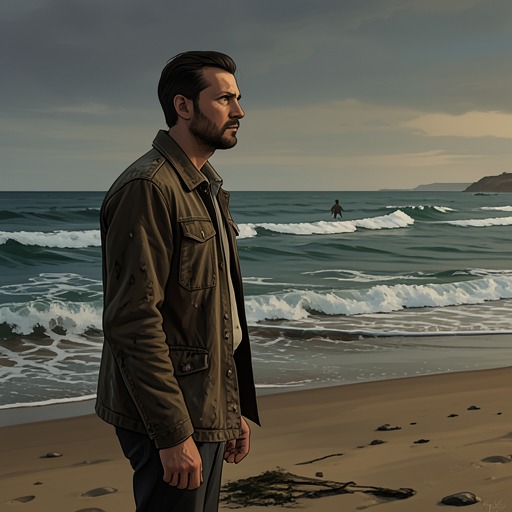
During a severe September typhoon, the town prepares for possible evacuation. After the storm’s eye passes, the narrator leaves the house to explore the damage and then heads toward the beach. K sees him on the road and comes outside; soon afterward, the narrator finds him squatting near the shore, absorbed in something on the ground. A deep rumbling and an unusual gurgling sound make the narrator realize that a huge wave is coming. K does not appear to hear the warning signs.
The narrator knows he should run to K, but fear sends him in the opposite direction, toward the breakwater. From there he shouts for K to get away. K looks up only when he hears the warning, and by then the wave is almost upon him. The narrator sees him turn toward it and attempt to run, but the wave reaches him first and carries him out of sight. The narrator remains on the breakwater rather than going down to search, afraid that further waves may follow. K is never found.
As the second wave approaches, the narrator sees K inside its crest, enclosed as if in a transparent capsule. K is looking at him, but his familiar friend seems transformed: he grins broadly, his eyes are cold, and he stretches out his right arm as though trying to draw the narrator toward him. The narrator loses consciousness. He wakes in his father’s clinic after three days of fever, unable to speak clearly; a neighbor who saw what happened has carried him home. The experience leaves him with an image of K that is inseparable from the moment he was swept away.
The Long Aftermath
The narrator stays away from his hometown for more than forty years and avoids not only that beach but other beaches, swimming pools, deep rivers, lakes, boats, and even air travel abroad. He fears that what he remembers as a dream could happen in reality, yet avoidance does not free him from the image of himself drowning. The memory remains attached to K’s reaching hand and to the narrator’s own escape, making the lost friend’s disappearance a persistent source of fear.
The return begins after the narrator’s father dies of cancer and his brother sells the old family house. While sorting the storage shed, the brother finds a carton of the narrator’s childhood belongings and sends it to him in Nagano. Among the contents is a bundle of paintings K had made and given him. At first the pictures revive the old terror: the narrator imagines K’s spirit might spring back to life from them and considers throwing them away. He cannot bring himself to do so. After several days of hesitation, he unwraps them again and makes himself look closely.
Watercolors and Narrative Significance
Most of K’s surviving pictures are landscapes of the familiar shore, ocean, pine woods, and town. Their clarity and color remain vivid after the years, and the narrator judges them more accomplished than he had remembered. As he studies them, memories of the places the boys visited and the things they did return with force. He recognizes in the paintings the boy K’s attentive way of seeing, then realizes that K’s eyes had once been his own: as a child, he too had looked at the world with an unclouded liveliness.
After this recognition, the narrator makes a habit of studying one of K’s paintings at his desk each day after work, sometimes sitting with a single picture for hours. The paintings bring back landscapes of childhood that he had shut out of memory. K’s importance therefore extends beyond the loss at the heart of the typhoon story. The friend whose disappearance fixed the narrator’s life around fear also left behind the means by which that life could reopen—to memory, to the shared past, and to the narrator’s own capacity to see.